
Last Updated : 24 Mar 2016
Transport
Ships
Railways
Trams
Railways
Liverpool & Manchester
Liverpool Overhead
Rainhill Trials
Regional Rail Map
Stations List
Contact
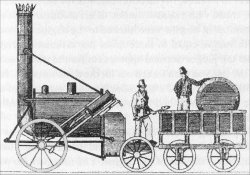 In the late 1820s, the Liverpool & Manchester Railway
Company directors were committed to using steam power for their new railway
but were divided on whether to use fixed engines or locomotives. George Stephenson (1781–1848) was their
“Engineer-in-Chief”. He was pro loco and also owner of a loco factory with son
Robert & partners. The board decided
to offer a £500 prize for an improved locomotive meeting certain
requirements. Much attention had been
given to the trials in press and many local and national news reporters came to witness them at Rainhill in October 1829. On a number of days it is recorded there were 10 to 15,000 spectators present.
In the late 1820s, the Liverpool & Manchester Railway
Company directors were committed to using steam power for their new railway
but were divided on whether to use fixed engines or locomotives. George Stephenson (1781–1848) was their
“Engineer-in-Chief”. He was pro loco and also owner of a loco factory with son
Robert & partners. The board decided
to offer a £500 prize for an improved locomotive meeting certain
requirements. Much attention had been
given to the trials in press and many local and national news reporters came to witness them at Rainhill in October 1829. On a number of days it is recorded there were 10 to 15,000 spectators present.
Only five competitors showed up on the first day of the
trials. A two mile stretch of track was
chosen because it was straight and level.
The new railway had double track unlike with one being used for the
trials. At the end of the first day the
judges returned to
|
|
Locomotive |
Weight |
Entered By |
From |
|
1 |
Novelty |
3 tons 15 cwt |
Braithwaite & Erickson |
|
|
2 |
Sans Pareil |
4 tons 8 cwt 2 qrs |
Hackworth |
|
|
3 |
Rocket |
4 tons 3cwt |
Robert Stephenson |
|
|
4 |
Cycloped |
3 ton |
Brandreth |
|
|
5 |
Perseverance |
|
Burstall |
|
Driving a locomotive in 1829 was quite a skill. There were no brakes and drivers had to reverse power to slow down.
Novelty, unlike Rocket arrived at Rainhill ‘untested’on track,
because there were no railway tracks in
San Pareil’s trial took place on Wednesday the 14th of October.
Robert Stephenson (1803–1859) built Rocket funded by George
Stephenson & Henry Booth.
He built the loco at “Forth Street Works”,
Cycloped, wh
Perseverance did not carry-out a trial as it had been
damaged in transit after the long sea journey to
After plenty of time for it’s competitors to show what they could do, Rocket was eventually declared the winner. The directors agreed to award the prize to “Messrs Booth, Stephenson & Stephenson”. The L&MR purchased the loco and placed orders for another four before the end of October 1829.