
Last Updated : 24 Mar 2016
Transport
Ships
Railways
Trams
Railways
Liverpool & Manchester
Liverpool Overhead
Rainhill Trials
Regional Rail Map
Stations List
Contact
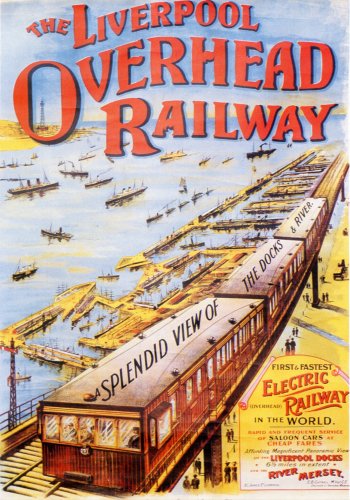 By the end of the 1840s, Liverpool’s docks ran from Brunswick Dock in the south to Wellington Dock in the north. The case for an efficient means of transport between docks which was not hindered by heavy road traffic existed. By 1852 rails were in place on the dock road with various branches serving docks, warehouses and works. In the early days steam locomotives were banned due to the fire risk amongst the cargoes but eventually the sailing ships themselves were replaced with steam ships.
W H Curtiss was one of the first to examine Liverpool’s dockland transport problems and proposed the idea of using the existing dockside railway to carry passengers as well as freight. However the first system which he introduced in 1859 used modified road omnibuses. An ingenious arrangement allowed flanges fitted to the back of their road wheels to be lowered and raised by means of a lever. By the 1880’s these special omnibuses were operating at a rate of up to 12 per hour. Despite the heavy tolls charged by the owner of the railway – the Mersey Docks & Harbour Board, they did continue to operate possibly into the 1890’s.
The idea of an elevated railway for Liverpool had its roots as early as 1852 when it was proposed by John Grantham to construct a 6 track, 4 mile line on 20 foot columns between Huskisson Dock and the Mersey Forge at Toxteth. The Mersey Docks & Harbour Board themselves also proposed an elevated railway in 1877 when they became concerned about dock road congestion. Their representative a George Lyster travelled to New York (where the first elevated railroad had opened in 1872) to look at examples there and later prepared plans for a double track line in Liverpool. Subsequently however the MD & HB sought parliamentary powers for only a single track line, with this being passed in 1878. Single track working was later condemmed by the Board of Trade.
The Liverpool Overhead Railway Company was formed in 1888 and powers were then transferred from the MD&HB to them. In 1891 it was decided to opt for an electric traction proposal instead of steam and by 1893 the first section of the railway was complete and rolling stock arriving. The railway was formally opened on the 4th of February, 1893 with public service commencing on the 6th of March 1893.
The Liverpool Overhead Railway was the only example of its kind in Britain, and was the first such railway anywhere in the world to be electrcally operated. The system had a total of 17 stations from Dingle in the south to Seaforth in the north where there was an interconnection with the Lancashire & Yorkshire Railway for onward travel as far as Southport.